Publication information
© His Majesty the King in Right of Canada, as represented by the Minister of Immigration, Refugees and Citizenship, 2025.
Cat. No. MQ1-16E-PDF (Electronic
PDF, English)
ISSN: 2816-7929
On this page
Dear Madame Chairperson,
This is the 7th annual report on the member complaints process under the Immigration and Refugee Board of Canada's (IRB)
Procedures for Making a Complaint About a Member, covering the period from April 1, 2024 to March 31, 2025.
During this period, my office had jurisdiction to receive and investigate complaints about the conduct of IRB members (decision-makers) across the 4 divisions of the Board: the Refugee Protection Division, the Refugee Appeal Division, the Immigration Division, and the Immigration Appeal Division.
This report contains information about the complaints received and/or finalized in fiscal year 2024-25. There were 7 complaints carried forward from the previous year, and 39 new complaints were received by my office.
Annex A contains case summaries of each complaint finalized in 2024-25.
In 2025-26, my office will take best practices and lessons learned from the last 5 years to refine and continue to strengthen the member complaints process, including the launch of an updated
Code of Conduct for Members of the IRB and
Procedures for Making a Complaint About a Member. We will continue to improve how complaints are managed in the most efficient way possible, addressing misperceptions of the complaints process and the change in types of complaints we receive, while reinforcing adjudicative independence and maintaining public and member confidence in the integrity of Canada's immigration and asylum system.
Stephanie Shatilla
Ombudsperson
Introduction: the Complaints process
The Immigration and Refugee Board of Canada (IRB) appointed an Ombudsperson in 2020, at which point the responsibility for member conduct was moved to that office. The Office is composed of 5 people: the Ombudsperson and 4 others, 3 of whom comprise the Member Complaints Directorate (the Director and 2 investigators).
The Ombudsperson's mandate regarding IRB member conduct is to ensure that complaints about non-compliance with the
Code of Conduct for Members of the IRB are thoroughly reviewed and appropriately addressed in a timely manner.
Among other responsibilities, the Ombudsperson oversees the complaints process, reports directly to the Chairperson, and is independent of the 4 divisions whose members are the subject of complaints. The Ombudsperson plays an important role by providing an impartial and confidential avenue for people to raise concerns about member conduct. Through this process, the Office ensures that the IRB and its members consistently uphold the high standards of behaviour required by the nature of their position, while maintaining both the confidentiality (outside of the parties) and transparency of the complaints process.
Many complainants struggle to distinguish between a member's conduct—which may warrant a formal complaint—and dissatisfaction with a member's adjudicative decision. While concerns about conduct are handled through the complaints process, disagreements with decisions must be pursued through an appeal to a higher tribunal (such as the Refugee Appeal Division (RAD) or the Immigration Appeal Division (IAD)) or by seeking judicial review in Federal Court. The complaints process is not intended to overturn decisions or request a different member. This misunderstanding partially explains the large number of complaints being screened out early in the complaints process.
The 2024-25 annual report provides an overview and breakdown of the complaints received, including the reasons for screening decisions, and results of investigations. It also includes timeliness statistics, and identifies areas where improvement to the process could be considered. The number and nature of complaints show a need for clearer tools—such as the website and complaint form—to help people understand what qualifies as member conduct that falls within the complaints process.
In 2025-26, an updated
Code of Conduct for Members of the IRB and
Procedures for Making a Complaint will be put in place. These updates reflect lessons learned over the past 5 years, including a shift in the types of complaints received. They aim to clarify for would-be complainants what is and what is not considered conduct. These updates ensure that the complaints process remains effective and focused on genuine conduct concerns.
Member complaints process
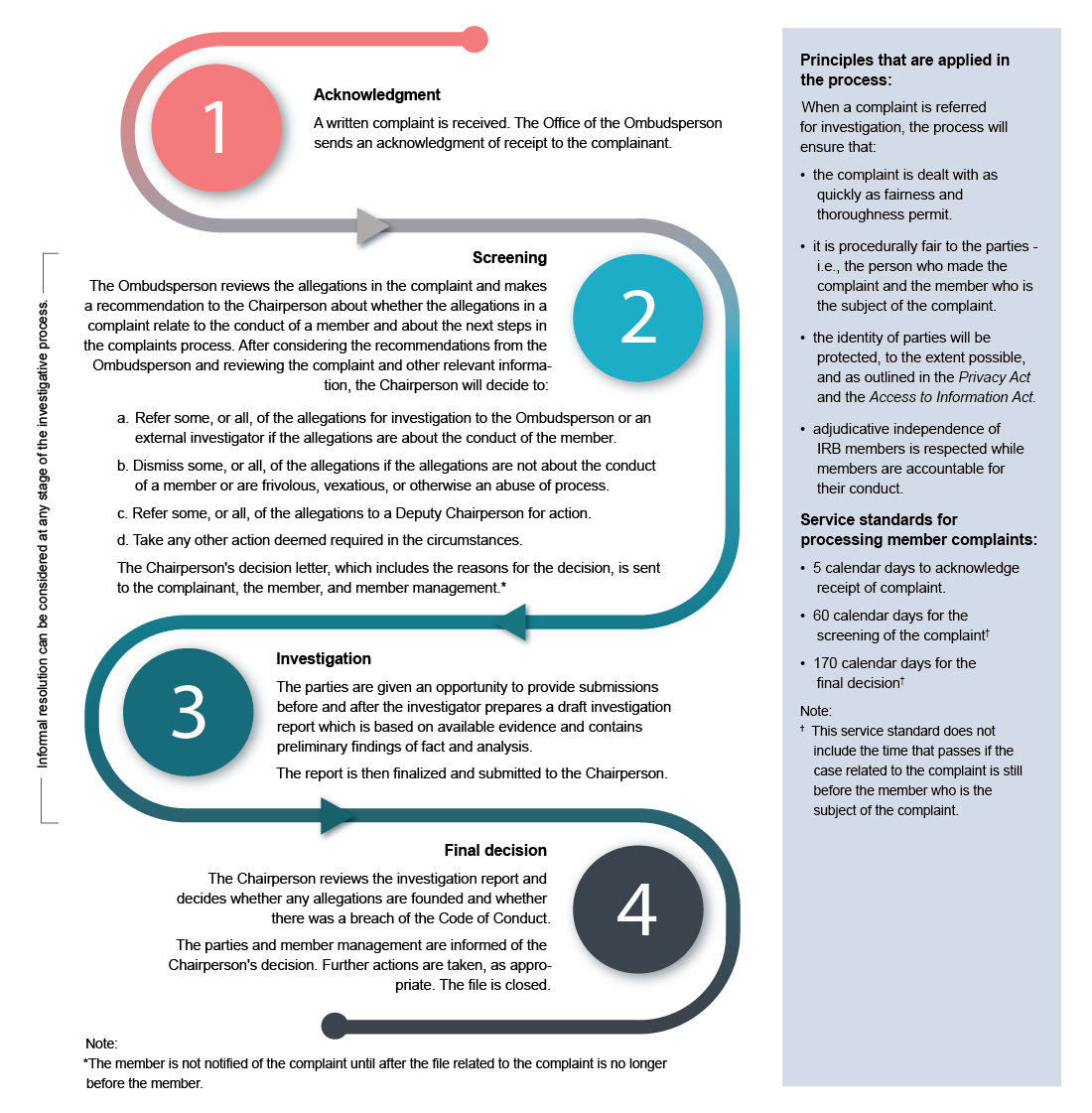
Text format - Member Complaints Process
Acknowledgment
A written complaint is received. The Office of the Ombudsperson sends an acknowledgment of receipt to the complainant.
Screening
The Ombudsperson reviews the allegations in the complaint and makes a recommendation to the Chairperson about whether the allegations in a complaint relate to the conduct of a member and about the next steps in the complaints process. After considering the recommendations from the Ombudsperson and reviewing the complaint and other relevant information, the Chairperson will decide to:
- Refer some, or all, of the allegations for investigation to the Ombudsperson or an external investigator if the allegations are about the conduct of the member
- Dismiss some, or all, of the allegations if the allegations are not about the conduct of a member or are frivolous, vexatious, or otherwise an abuse of process
- Refer some, or all, of the allegations to a Deputy Chairperson for action
- Take any other action deemed required in the circumstances
The Chairperson's decision letter, which includes the reasons for the decision, is sent to the complainant, the member, and member management.*
* The member is not notified of the complaint until after the file related to the complaint is no longer before the member.
Investigation
The parties are given an opportunity to provide submissions before and after the investigator prepares a draft investigation report which is based on available evidence and contains preliminary findings of fact and analysis.
The report is then finalized and submitted to the Chairperson.
Final decision
The Chairperson reviews the investigation report and decides whether any allegations are founded and whether there was a breach of the Code of Conduct.
The parties and member management are informed of the Chairperson's decision. Further actions are taken, as appropriate. The file is closed.
Principles that are applied in the process:
When a complaint is referred for investigation, the process will ensure that:
- the complaint is dealt with as quickly as fairness and thoroughness permit
- it is procedurally fair to the parties - i.e., the personwho made the complaint and the member who is the subject of the complaint
- the identity of parties will be protected, to the extent possible, and as outlined in the
Privacy Act and the
Access to Information Act
- adjudicative independence of
IRB members is respected while members are accountable for their conduct
Service standards for processing member complaints:
- 5 calendar days to acknowledge receipt of complaint
- 60 calendar days for the screening of the complaint†
- 170 calendar days for the final decision†
†This service standard does not include the time that passes if the case related to the complaint is still before the member who is the subject of the complaint.
Statistics
Member complaints in 2024-25
In 2024-25, the IRB had an average of 733 members who finalized 102,500 decisions. For that period, 39 new complaints were received. By comparison, the previous fiscal year saw 678 members finalize about 80,000 files, while 19 complaints were received.
Seven complaints from 2023-24 were carried over, bringing the total number of active complaints in 2024-25 to 46. A total of 28 of these complaints were finalized before March 31, 2025. The increase in finalized IRB decisions is a likely contributor to the increase in total complaints received. However, the proportion of complaints that resulted in a confirmed breach remained consistent—1 founded complaint in 2023–24 and 2 in 2024–25.
Why an allegation is screened in or out
Most complaints received in 2024-25 contained a mix of allegations, some related to conduct and some not. The allegations deemed outside the scope of the Procedures are screened out of the process. Examples include asking for a new member to hear a case, appealing a member's final decision, disagreeing with questions the member asked during a hearing, or disagreeing with a ruling that the member made during the hearing.
Screened out – Relates to adjudicative independence (2024-25)
| ReasonFootnote 1 | Number of references |
|---|
Member's decision | 9 |
Hearing management | 9 |
Breaks given (or lack thereof) | 3 |
Interrupting testimony | 3 |
Language interpretation issues | 3 |
This year included the first 2 complaints that were deemed frivolous, vexatious, or otherwise an abuse of process (files
24-003 and
24-020). This provision was included in the Procedures in 2022 to be responsive to allegations that, while related to conduct, were dismissed because they lacked legal merit, seriousness, or reasonable purpose.
Figure 1: Finalized complaints by outcome in 2024-25
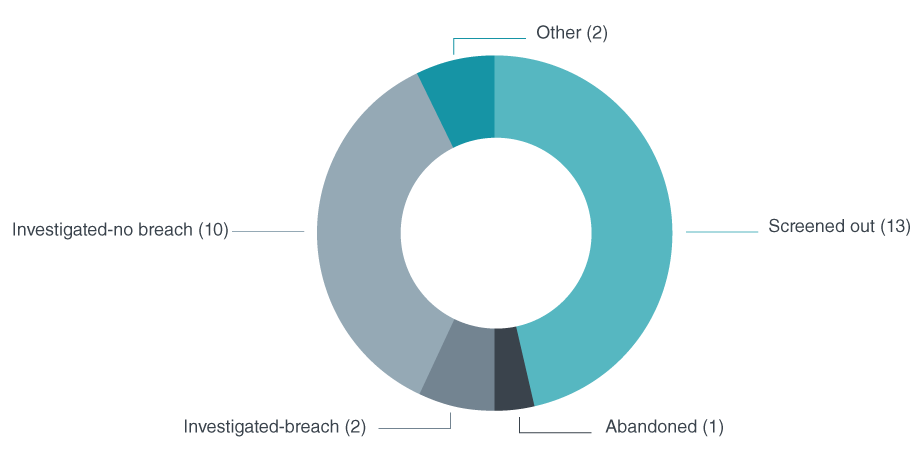
Text format - Complaints by outcome 2024-25
Complaints by outcome 2024-25
| Outcome | Number of decisions | Description of the outcome |
|---|
Screened out | 13 | The allegations were not about conduct. Most of these allegations were about a member's decision, hearing management, or the way the Member questioned parties.
Two allegations were screened out for being frivolous and vexatious. |
Investigated – No breach | 10 | Investigations found that either the alleged conduct did not occur, or that there was not enough evidence to support a finding of a breach of the Code. |
Investigated - Breach | 2 | One member was found to have breached sections 11 and 12 outside of a hearing room.
One member was found to have breached section 9 during a hearing. |
Abandoned | 1 | Complainant did not respond to further emails. |
Other | 2 | Not enough information was received to form the basis of a complaint. |
In 2024–25, complaints were received about members from 3 of the 4 divisions of the IRB. The Refugee Protection Division (RPD) is the largest tribunal at the IRB; it was responsible for approximately 77% of decisions, 69% of members, and 79% of hearings during the reporting period. The RPD accounted for 79% of all complaints received. Members from the Immigration Division (ID) and IAD were the subject of 4 complaints per division. No complaints were received about members of the RAD, likely due to the limited volume of hearings conducted by the RAD. In 2024-25, the RAD held only 35 hearings, making it the division with the fewest proceedings at the IRB.
In 2024-25, about 54% of complaints received were from counsel and 33% from self-represented individuals. The remaining complaints were submitted by Minister's Counsel (5%) and interpreters (5%). One complaint (2%) came from a member of the public who reported the content of a video posted by a member on the Member's personal social media account.
Timeliness
During this reporting period, complaints were (see
Table 1 below):
-
acknowledged within the established service standard
97% of the time
-
screened within the service standard
52% of the time
-
final decision letters sent within the service standard
50% of the time
Table 1: Service standards results for 2024-25
| Type | Description | Standard | Target % | 2024-25 Result % |
|---|
Acknowledgment | Acknowledgment letter sent to complainant following receipt of the complaint | 5 calendar days from receipt of complaint | 100 | 97 (27/28) |
Screening | Screening decision letters sent to parties following screening | 60 calendar daysFootnote 1 from receipt of complaint | 80 | 52 (13/25) |
Final decision | Final decision letters sent to parties following investigation | 170 calendar daysFootnote 1 from receipt of complaint | 80 | 50 (6/12) |
Observations and trends
Complaints can be about conduct that is believed to breach sections 9 to 15 of the Code. Since the appropriate section(s) of the Code are not always identified in a complaint, allegations are triaged when they are received to confirm which ones fall under which section of the Code for the purpose of screening. Almost all complaints alleged a breach of section 9 of the Code (26 references). None of the complaints referenced sections 13, 14, or 15 of the Code.
Sections of the Code of Conduct referenced in complaints
| Section of the Code | Full text | Number of references |
|---|
9 | Members shall conduct hearings in a courteous and respectful manner. | 26 |
10 | Members shall exercise their duties without discrimination. Members must take reasonable measures to accommodate all participants in a proceeding so that they may participate effectively. Members are expected to take into account social and cultural differences and to respect human rights. | 18 |
11 | Members are expected to act honestly and in good faith, in a professional and ethical manner. | 26 |
12 | Members shall conduct themselves with integrity and avoid impropriety, or the appearance of impropriety. | 15 |
All complaints that are screened in for investigation are assessed for possible resolution through Alternative Dispute Resolution (ADR). None of the attempts at ADR in 2024-25 were successful. This was because either the complainant or the member was not interested in this method to resolve the complaint. ADR is voluntary and both parties must be willing to try it.
In 2024–25, the IRB received its first complaint from a member of the public about a member's conduct outside of a hearing (file
24-004). This highlights that IRB members are seen as public figures, and their behaviour—both inside and outside the hearing room—must follow the IRB's Code of Conduct. The Code requires members to remain neutral, impartial, and avoid any behaviour that could appear improper.
In addition to the IRB's Code of Conduct for Members, all IRB staff—including public servants and Governor in Council appointees—are also bound by the
Values and Ethics Code for the Public Sector and the
IRB's Code of Conduct for Public Servants.
Conclusion and looking forward
The types of complaints we received in 2024-25 helped shape updates to the ongoing revision to the
Code of Conduct for Members of the IRB and the
Procedures for Making a Complaint about a Member. The revised Code will be more succinct and reflective of members' obligations and expectations. The updated Procedures will guide both members and complainants through the process.
To support prevention, the Office of the Ombudsperson contributed to member training throughout the year. This included sessions on social media use, the Code of Conduct, the complaints process, and the role of the Ombudsperson. Employees of the Member Complaints Directorate also continued to build their own expertise, including training on effective hearing room management.
Going forward, the Office of the Ombudsperson will focus on continuing to screen and investigate complaints efficiently, keeping in mind the changing volumes at the IRB.
In the coming year, the Office will also focus on the launch and implementation of the new Code of Conduct and Procedures. In support of the new Code and Procedures, the website and complaint form will be updated to be clearer, and information sessions will be provided to members in order to answer any questions they might have.
Annex A – Case summaries