-
Introductory remarks
-
IRB at-a-glance
-
Budget and HR
-
Divisions
-
Refugee Protection Division – Key Facts
-
Processing and Wait Times (Current)
-
Acceptance Rates for Top 10 Countries
-
Task Force on Less Complex Claims
-
Levers Impacting Processing Timelines
-
Refugee Appeal Division – Key Facts
-
Immigration Division – Key Facts
-
Immigration Appeal Division – Key Facts
-
Topics of Interest
-
Bill C-12 – Impact on IRB
-
Integrity
-
Direction on Prescribed Presence in the Workplace
-
Annex A: Committee Information
Introductory remarks
Opening Remarks to The Standing Committee on Citizenship and Immigration
Date:
Introduction
Thank you, Mme. Chair and members of the Committee, for inviting the Immigration and Refugee Board to speak about the Board’s role in with respect to the In-Canada Asylum system.
I am here as the Chair of the Immigration and Refugee Board. Accompanying me are the Deputy Chair of the Refugee Protection Division, Roula Eatrides, and the Executive Director of the IRB, Roger Ermuth.
About the Board
The IRB is an independent tribunal, established by Parliament in1989.
Our mandate is to resolve immigration and refugee matters efficiently, fairly, and in accordance with the law.
We report to Parliament through the Minister of Immigration, Refugees and Citizenship.
As a tribunal, we have a high degree of institutional independence.
The decisions which we render in all four divisions of the Board must conform, not only with the
Immigration and Refugee Protection Act (IRPA), the
Canadian Charter of Rights and Freedoms, the jurisprudence established by the Federal Courts and the Supreme Court of Canada but also, international conventions to which Canada is a signatory.
Given the serious nature of what we adjudicate and the rights involved – life, liberty, security – the case law has reaffirmed that the IRB must afford parties a high degree of procedural fairness at all times.
Results
The IRB issued 102,000 decisions last year – a historic level of output. Of those, over 78,000 were decisions from the Refugee Protection Division. This is worth mentioning, considering the IRB was funded to issue 60,000 files.
78,000 represented a 42% productivity increase from the year before. That was not out of luck, but the result of hard work, focussed on simplifying our processes, process automation where possible, and rigorous case management.
Today we are scheduling close to 310 refugee protection hearings a day. Close to 90% of these hearings will require the presence of an interpreter to ensure the claimants understand the proceedings and fully participate in them.
We aim to achieve up to 85,000 finalisations this year. This is an increase from last year. To achieve it, we will continue our transformation allowing us to manage our caseload as one national inventory, to maximise the flexibility offered by becoming more and more a digital tribunal. We also relentlessly pursue our efforts to simplify our internal processes and facilitate digital communications with claimants and their representatives.
We have a case portal – My Case – where claimants and counsel can submit documents and receive communication digitally.
The registry has also been significantly streamlined – moving to a national registry model allowed for one mailstop and one phone number.
Intake
These excellent results are overshadowed by the fact that 176,000 asylum claims were referred to the IRB last year and another 155,000 the year before.
We expect to receive around 100,000 asylum claims by the end of this fiscal year. That leaves us, as of September 30, with a caseload of 296,200 claims, of which 103,400 are not ready to be heard.
A case decided today takes on average 22 months – of which 16 months were attributed to IRB’s wait time. A case referred today will be heard in 44 months if there are no other priorities.
Closing
Our principal challenge stems from an intake that is twice the IRB’s funded capacity. We have been making great strides in our goal to issue as many decisions as there are claims referred in a year, but we are not there. We may never be if conditions do not change. However, I am not losing hope.
We are continuing to do everything in our power to be as efficient as feasible.
I started my comments outlining the nature of the rights at stake and the corresponding obligations to hear and decide these cases, ensuring the required standard of natural justice, applying the stringent caselaw as it has developed in the past 36 years.
I will end with the same point, by saying that I am, and so is every board member of the IRB, very aware of the task upon us – to make transparent, justified and clear decisions, quickly, fairly, and effectively, in accordance with the law.
Mr/Madame Chair of this Committee, I will stop now and welcome your questions.
IRB at-a-glance
Corporate
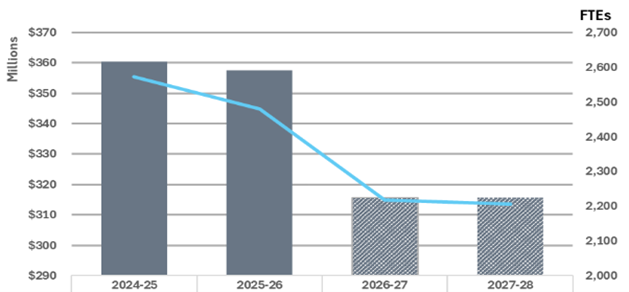
Text version
Total budget
| 2024-2025 | 2025-2026 | 2026-2027 | 2027-2028 |
|---|
| Authorities |
$360,445,208 |
$357,614,733 | | |
| Budget projections | | |
$315,713,253 |
$315,712,641 |
| FTEs | 2,573 | 2,480 | 2,218 | 2,206 |
| Budget 2024-2025 | Actuals (,000) |
|---|
|
Salary |
$298,808 |
|
O&M | |
| Interpreters | $10,450 |
| Translation | $7,712 |
| Transcription | $4,632 |
| Designated Reps | $465 |
| All other O&M | $30,808 |
|
Total O&M |
$54,067 |
|
Total |
$352,875 |
Directive on Telework
- 3-day a week on site: Managers' attestation and card swipes
- Calgary - exception
- Pre-existing telework groups including linguistic specialists/RAD members
Horizon efficiencies
- 1-800 Phone and Mail consolidation
- RPD Process leaning of Intake and Scheduling
- My Case Onboarding of all counsel, DRs and pilot of self represented
- NOVA automation of intake tasks and forms
- Reasons Navigator
- Manager self-service productivity
- Inventory management tools to improve triage
ID/IAD/RAD
| ID decisions / wait times | Decisions (Q1 & Q2 2025-2026 | Wait time
as of September 30th, 2025 |
|---|
| Immigration |
|---|
| Detention | 3,600 | 48 hours/ 7 days / 30 days |
| Admissibility | 1,100 | 4 months |
|
Immigration appeals |
2,100 |
5 months |
| Family sponsorship appeals | 70% | |
| Admissibility appeals | 19% | |
| Permanent residency appeals | 10% | |
| Appeals by the Minister | 1% | |
|
Refugee appeals |
5,100 |
4 months |
| Interventions by the minister | 2% | |
|
Total RAD-ID-IAD Decisions Q1/Q2 |
11,900 | |
| Total decisions (rounded) | 2022-2023 | 2023-2024 | 2024-2025 | 2025-2026 (Q1 and Q2 inclusively) |
|---|
|
Refugee Appeal Division |
10,900 |
9,800 |
9,400 |
5,100 |
|
Immigration Division |
10,300 |
11,300 |
10,400 |
4,700 |
| Detention Reviews | 8,900 | 9,500 | 8,300 | 3,600 |
| Admissibility Hearings | 1,400 | 1,800 | 2,100 | 1,100 |
|
Immigration Appeal Division |
3,100 |
3,200 |
4,000 |
2,100 |
|
Total |
24,300 |
24,300 |
23,800 |
11,900 |
ID detention-related figures (October 20, 2025)
| Days detained | Number of persons concerned (figures from last update) |
|---|
| 1-180 days | 127(128) |
| 181-365 days | 8(10 |
| 365+ days | 1(1) |
|
Days detained |
Mean length |
Median length |
| 1-180 days | 62 | 54 |
| 181-365 days | 261 | 252 |
| 365+ days | 885 | 885 |
| Persons detained | | |
| All detainees | 90 | 63 |
RPD
| Decisions/wait times 2025-2026 | Decisions (Q1 & Q2 2025-2026 | Wait time |
|---|
|
Refugee claims |
39,000 |
22 months |
| Security screening | 100% | |
| Interventions by the Minister | 7% | |
| Total asylum claim inventory | Total claims (rounded) |
|---|
|
Not ready for adjudication |
103,400 |
| With claimant | 4,600 |
| Pending security screening by CBSA | 76,600 |
| Other (pending Minister's Information Package or other documents) | 22,100 |
|
Ready for adjudication |
192,900 |
|
Total |
296,200 |
RPD finalizations
per region | 2022-2023 | 2023-2024 | 2024-2025 | 2025-2026 (Q1 and Q2 inclusively) |
|---|
| # | % | # | % | # | % | # | % |
|---|
| Western | 8,200 | 17% | 8,900 | 16% | 13,200 | 17% | 6,500 | 17% |
| Central | 26,200 | 54% | 30,700 | 56% | 38,700 | 49% | 21,200 | 54% |
| Eastern | 13,800 | 29% | 15,700 | 28% | 26,800 | 34% | 11,300 | 29% |
|
Total |
48,200 |
100% |
55,300 |
100% |
78,700 |
100% |
39,000 |
100% |
Overturned Cases (Q1 & Q2 of 2025-2026)
| Federal Court overturn rate of asylum decisions (FY to date) | <1% | 25 |
| Top Source Countries for Asylum Claims in Inventory as of September 30th, 2025 | Total Claims Pending (rounded) | % of Intake | Acceptance Rate in 2025-2026 FYTD |
|---|
|
Top 5 countries |
139,500 |
47% |
47% |
| India | 43,900 | 15% | 26% |
| Haiti | 29,600 | 10% | 66% |
| Mexico | 24,500 | 8% | 41% |
| Nigeria | 21,500 | 7% | 69% |
| Bangladesh | 20,000 | 7% | 50% |
|
Other 183 countries |
156,700 |
53% |
74% |
|
Total |
296,200 |
100% |
64% |
| Acceptance rate at the IRB | 2022-2023 | 2023-2024 | 2024-2025 | 2025-2026 (Q1 and Q2 inclusively |
|---|
|
Top 5 countries in inventory |
48% |
46% |
40% |
47% |
| India | 48% | 49% | 26% | 26% |
| Haiti | 48% | 60% | 59% | 66% |
| Mexico | 41% | 35% | 32% | 41% |
| Nigeria | 55% | 65% | 68% | 69% |
| Bangladesh | 71% | 77% | 56% | 50% |
|
Other countries |
74% |
80% |
74% |
74% |
|
Total |
65% |
69% |
61% |
64% |
Notification of the Minister
- The IRB sends approximately 4,000 notifications to the Minister annually to IRCC and CBSA to signal issues including integrity concerns.
- Roughly 20% of these notifications (approx. 800) result in interventions by the Minister.
Budget and HR
Key messages
- The IRB budget:
- Main Estimates for FY 2025–26: $345.4M
- Carry forward + Workforce Economic Increases and Adjustments: $12.2M
- Total authority to $358M.
- Approximately 2,480 FTE
- including approximately 420 public servant decision-makers and 134 GiC decision-makers
- The budget is set to drop by $45M (12.5%) in FY 2026-27 from 2024-25 final authorities.
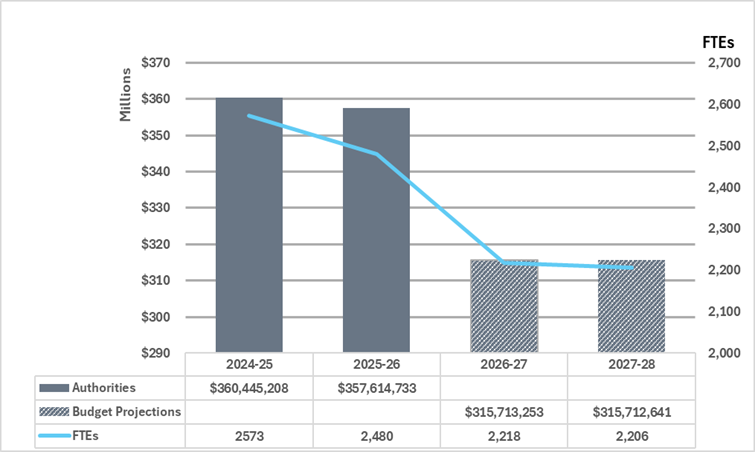
* Based on public accounts and current approved reference levels
Text version
Total budget
| 2024-2025 | 2025-2026 | 2026-2027 | 2027-2028 |
|---|
| Authorities | $360,445,208 | $357,614,733 | | |
| Budget projections | | | $315,713,253 | $315,712,641 |
| FTEs | 2,573 | 2,480 | 2,218 | 2,206 |
O&M: Most expenditures on contracts support direct adjudication costs – see chart. The IRB has reduced all discretionary costs, including on travel.
Fiscal year 2024 to 2025
| Expenditures | Actuals |
|---|
| Transportation and communications | 1,534 |
| Information | 425 |
|
Professional and special services |
39,150 |
| Interpreters services | 10,450 |
| Translation services | 7,712 |
| Transcription services | 4,632 |
| Protection services | 2,568 |
| All Others professional and special services | 13,788 |
| Rentals | 8,008 |
| Repair and maintenance | 1,689 |
| Utilities, material and supplies | 307 |
| Acquisition of land, buildings and works | 0 |
| Acquisition of machinery and equipment | 2,913 |
| Other subsidies and payments | 41 |
| Total budgetary expenditures | 54,067 |
Divisions
Refugee Protection Division – Key facts
Key messages
- Fiscal year to date (to September 30, 2025), the RPD finalized over 39,000 cases, with a
publishedtarget for the fiscal year of
80,000 finalizations.
- During the same period, the RPD received approximately
53,900 asylum claim referrals, a decrease in referrals of 46% compared to the period of April to September 2024 (99,800 claims).
- As of September 30, 2025,
- inventory of
192,900 claims that
are ready to be heard.
- A further
103,400 claims
are incomplete due to a pending security screening and/or other outstanding requirement.
- The
acceptance rate for the first half of FY 2025-26 was
64%, which is aligned with the average of the past three years of
64%. Fluctuations occur over time due to volume of intake by country and type of claims received.
- We continue to perform above funded levels.
Key statistics
-
Status: As of September 30, 2025, about 35% of the current inventory of refugee claims were not ready for scheduling, which means they cannot proceed to a hearing and finalization due to a pending security screening and / or other outstanding requirements.
-
Age: 41 % of pending claims were less than 1 year old (received between October 2024 and September 2025.)
- 46% of cases were received between October 2023 and September 2024.
- 13% of cases were received in or prior to October 2023.
-
Claimants’ location:
- 37% Quebec,
- 46% in Ontario,
- 12% in the Western provinces
- 1% in Maritime provinces.
- 4% have yet to provide a valid address.
- Average wait time for a decision at the RPD at the end of September 2025 was 22 months from the time of referral and 16 months from the time a claim is ready for adjudication:
All claims
| Inventory composition by age of claims | Total volumes | Total proportion |
|---|
| < 12 months | 122,400 | 41% |
| 1-2 years | 136,100 | 46% |
| 2+ years | 37,700 | 13% |
Country make-up
| All claims source country | Total claims pending | % of inventory |
|---|
|
Top 10 countries |
189,800 |
64% |
| India | 43,900 | 15% |
| Haiti | 29,600 | 10% |
| Mexico | 24,500 | 8% |
| Nigeria | 21,500 | 7% |
| Bangladesh | 20,000 | 7% |
| Sri Lanka | 12,600 | 4% |
| Iran | 10,400 | 4% |
| Ghana | 9,600 | 3% |
| Colombia | 9,200 | 3% |
| Pakistan | 8,500 | 3% |
|
Other 179 countries |
106,400 |
36% |
Processing and wait times
Key messages
- As of September 30th, 2025:
- claims decided take
22 months from referral to decision
-
once they were ready for adjudication: 16 months
- Front End Security Screening (FESS) + frontend processes take
6 months on avg
- Last fiscal year, the IRB issued
78,700 decisions, an increase of 42% from the previous year’s output of 55,300 decisions.
- IRB’s funded capacity for RPD was
60,000 in FY2024-25 (57,500 of funded capacity and 2,500 in commitment of efficiency gains).
- With intake higher than IRB’s funded capacity, and despite significant investments in productivity,
wait times will continue to grow as the inventory of cases continues to grow – it sits at over
296,000 cases today and intake continues to exceed capacity.
Background
- As of September 30th, 2025, the RPD inventory was comprised of more than
296,200 claims, representing
51 months of work at the
RPD’s funded capacity for 2025-26 of 70,000 claims per year.
- Approximately 35% of this inventory (103,400 claims) were awaiting documents from external parties or the claimant before the claim can be scheduled for adjudication.
-
Budget 2024 provided permanent funding to the IRB starting in 2025-26, providing the Refugee Protection Division with the capacity to finalize
70,000 claims a year.
- The implementation of the Horizon 2026-27 initiatives has supported an increase in RPD claims finalizations from 78,700 in 2024-25 to a projected 85,000 in 2025-26. Next year’s output will be reduced with budget reductions and pending Comprehensive Expenditure Review.
- While the IRB workforce has grown by 156% since FY 2015/16, during the same period, asylum decision output has grown by over 417% and asylum claims intake has grown by 921%.
- Growth in asylum decisions output: 15,200 decisions rendered by the RPD in 2015-2016 and 78,700 decisions rendered by the RPD in 2024-25 = a growth of 417%.
- Growth in asylum claims input: 16,700 claims received at the RPD in 2015-2016 and 170,500 claims received at the RPD in 2024-25 = a growth of 921%.
Claim acceptance rates
Global acceptance rates by calendar years and 2025 YTD
| Year | Acceptance rates |
|---|
| January-September 2025 inclusively | 62% |
| 2024 | 62% |
| 2023Note 1 | 70% |
| 2022 | 61% |
| 2021 | 62% |
| 2020 | 61% |
| 2019 | 57% |
| 2018 | 53% |
| 2017 | 61% |
| 2016 | 61% |
| 2015 | 57% |
- Note 1
A larger than usual proportion of claims finalized in 2023 were from countries with higher acceptance rates, such as Iran and Turkiye, which impacted the overall acceptance rate for that period.
Return to note 1 referrer
Task Force on Less Complex Claims (TFLCC)
Key messages
-
Subsection 69.1(7.1) of the former
Immigration Act back in
1993, allowed the IRB to accept claims without a hearing.
- This authority was
continued in 2002 under paragraph
170(f) of the
Immigration and Refugee Protection Act - it explicitly provides that the Refugee Protection Division (RPD) may “…
allow a claim for refugee protection without a hearing, if the Minister has not notified the Division, within the period set out in the rules of the Board, of the Minister’s intention to intervene”.
- In January 2019, the IRB put in place a Task Force on Less Complex Claims (Task Force or TLFCC) to ensure that resources are used efficiently and, in a manner, proportionate to the complexity of the claim.
- The TLFCC is guided by the principles of fairness, efficiency, and integrity.
- Claims can be granted a positive decision without a hearing, or, if only one or two issues need to be resolved, can proceed with a short hearing.
- If on review the case does not meet criteria, it reverts to a full hearing process.
-
No claim is heard or decided without Front End Security Screening (FESS)
and the Minister may intervene in any refugee claim, including a TLFCC claim.
- The processing time for finalizing less complex claims on merit in the first half of FY 2025-26 was
11 months, compared with 20 months for other claims over the same period, including the time required for claims to be ready for adjudication (i.e. to receive the Minister's Package, the Basis of Claim, FESS, etc).
Background
- National procedures for exercising this jurisdiction were first adopted at the IRB in 1993 and later formalized in the IRB’s Policy on the Expedited Process issued in 2001.
Finalizations
- In the first half of FY 2025-26, approximately
27,400 claims were streamed to the less complex process, with approximately
13,200 sent back for processing as part of the regular stream.
- In the first half of FY 2025-26, the members of the Expedited Cases Team finalized approximately 9,000 less complex refugee claims, or 23% of the total 39,000 refugee claims decided. Of the
9,000 less complex claims finalized:
- 62% through the file review process (5,600 refugee claims);
- 29% through a short hearing (2,600 refugee claims); and,
- 9% were abandoned, withdrawn, or otherwise concluded (800 refugee claims).
Acceptance rates in the Task Force are broken down as follows:
- Of the less complex claims that are processed by the ECT:
- 100% of the files finalized through the file review process were accepted (as a general rule, no claims are refused without a hearing).
- Out of the claims heard in short hearings, 96% were accepted.
Criteria:
- The RPD generally considers the following criteria when determining if a country or claim type is appropriate for the file-review process:
- Countries or claim types that have an acceptance rate of 80% or higher.
- Countries or claim types where identity is generally established by reliable documents.
- Countries or claim types where the evidence is not ambiguous regarding the risk generally faced by claimants.
- Countries or claim types where complex legal or factual issues do not often arise at the hearing.
- Many Task Force claims arise from conflict situations and changing country conditions.
███████████████████████████████████████████████████████████████████████████████████████████████████████████████████████████████████████████████████████████████████████████████████████████████████████████
Levers impacting processing times
Key messages
The following impact processing time:
-
IRB Processing Capacity– must be equal to intake, i.e., system must be at equilibrium (intake = adjudicative capacity).
- Efficiency gains have increased processing capacity and will continue to do so, but currently not a match for intake.
- The IRB has no control over intake
-
Timely Front-End Security Screening (FESS) Processing
-
Ministerial Review and Intervention Capacity (Minister’s Due Diligence) - Timely front-end processing (i.e. receiving a complete file from the Minister: seized documents, interview notes, notice of intervention, etc.) is key to overall processing timeline
-
Counsel Availability – Counsel availability directly affects the ability to schedule a hearing.
-
Interpreter Availability – Interpreter availability directly affects the ability to schedule a hearing.
-
Access to Legal Aid – Where claimants elect to have counsel, early access to legal representation is essential for timely processing of refugee claims (e.g., timely receipt of BOC). In addition, the fee structure must be conducive to timely processing of claim.
-
Changes to the rules – Changes to the rules would be required to support operational efficiency.
-
Reduction of the Current Inventory – The current pending inventory of claims is approximately 300K. Inventory should be reduced to a working inventory, which represents between 6-9 months of processing capacity. Failure to tackle the inventory will result in longer processing time.
Refugee Appeal Division – Key Facts
Key messages
- Last fiscal year the RAD rendered
9,400 decisions.
- In the first half of Fiscal Year (FY) 2025-26 (April to September 2025 inclusively), the Refugee Appeal Division (RAD) finalized approximately
5,100 appeals.
- 29% of appeals decided were allowed, while 70% were dismissed, and 1% were withdrawn or administratively closed.
- For the same period, approximately 535 applications for leave contesting RAD decisions were submitted to the Federal Court.
- The Federal Court granted approximately 40 applications for leave and overturned approximately 25 RAD decisions, representing less than 1% of the decisions rendered at the RAD for the period.
- As of the end of September 2025, the average wait time for a decision from the time the appeal was filed was 4 months.
Inventory
- Scope: At the end of September 2024, the RAD inventory was comprised of approximately 3,900 appeals, up to 30% in 12 months and about 63% down from its peak of 10,400 in September 2019.
|
All Appeals Source Country |
Total Appeals Pending at Sept 30, 2025 |
% of Inventory | Acceptance Rate in 2025-2026 (Q1 and Q2 inclusively)
Note 1 |
|---|
|
Top 10 Countries |
2,590 |
66% |
28% |
| India | 700 | 18% | 25% |
| Mexico | 470 | 12% | 25% |
| Nigeria | 440 | 11% | 32% |
| Bangladesh | 330 | 8% | 30% |
| Pakistan | 160 | 4% | 36% |
| Ghana | 120 | 3% | 25% |
| Colombia | 110 | 3% | 27% |
| Kenya | 110 | 3% | 27% |
| Congo, Democratic Republic of the | 80 | 2% | 35% |
| Jordan | 70 | 2% | 27% |
|
Other 96 countries |
1,310 |
34% |
29% |
- Note 1
Percentage of appeals by refugee claimants for which the RAD has substituted a positive decision or returned the claim to the RPD for redetermination, out of all appeals finalized by the RAD for the period.
Return to note 1 referrer
Immigration Division – Key Facts
Key messages
- Last fiscal year the Immigration Division (ID) rendered 10,400 decisions: 8,300 Detention Reviews and 2,100 Admissibility hearings.
- In the first half of FY 2025-26 (April to September 2025 inclusively), ID finalized approximately
3,550 detention reviews and
1,140 admissibility hearings.
- The target for 2025-26 for admissibility hearings is at least 1,200 and at least 9,000 for detention reviews.
- ID is experiencing an upward intake trend in admissibility hearings of 21% over the past 3 years (from 1,700 in the 12-month period ending in September 2023 to 2,100 in the most recent 12-month period). We continue to monitor this trend closely.
- In the first half of FY 2025-26, 80% of admissibility hearings were conducted within 4 months.
- Detention reviews in the first half of FY 2025-26
- 99% of more than 3,550 detention reviews were concluded within legislative requirements (target of no less than 96%).
- 21 persons were detained for 180 days or more at any point during the first half of FY 2025-26.
Immigration Appeal Division – Key Facts
Key messages
- Last fiscal year, the Immigration Appeal Division (IAD) rendered 4000 decisions.
- In the first half of FY 2025-26 (April to September 2025 inclusively), IAD decided on approximately
2,070 cases and is on track to decide at least 3,000 appeals for the fiscal year.
- IAD is experiencing an upward intake trend from last year, from 3,300 cases in the previous 12-month period to 4,500 (+36%). We continue to monitor this trend closely.
- IAD finalizations have surpassed or matched intake for the past 11 years.
- The average wait time for a decision at the IAD as of the end of September is approximately 5 months.
- In the first half of FY 2025-26, 38% of appeals decided were allowed, while 36% were dismissed.
- The abandonment and withdrawal rates remained stable year-over-year at around 7% for abandonments and 19% for withdrawals.
Topics of interest
Bill C-12 - Impact on IRB
Key messages
- Independently from C-12, the IRB is pursuing strategic initiatives to optimize its productivity within its current budget. In fiscal year 2024-25, finalization of claims exceeded its funded capacity 31% (78,700 finalizations, compared to a 60,000 funded capacity).
- It is difficult to fully assess the operational impact of C-12 on the IRB as much is dependent on the Regulations, which we have not seen.
- The hope is that if implemented in cooperation with the IRB, these measures could reduce multiple administrative transactions between the RPD registry and IRCC, help reduce the number of postponements, improve case scheduling, and streamline the triage of claims through our expedited case management process.
- Implementation is expected next fiscal year, which can pose a challenge at a time where the IRB will be facing significant budget reductions.
- Given the large size of the current inventory of refugee claims, if adopted, it is expected that the impact of Bill C-12 will be gradual. Just how gradual is dependent on level of intake and funded capacity.
- We have heard from asylum stakeholders that they are concerned that protection cases deemed ineligible going forward will not have access to the IRB.
Anticipated Impact of Bill C-12 on the Operations of the Board
-
Single Online Application: These changes will grant the Minister authority to specify the information and documents asylum claimants must provide when initiating a claim. Claimants will be required to provide to the Minister all information and documents specified by the Minister and information required by the rules of the Board (i.e., a complete Basis of Claim (BOC) form). Timelines will be prescribed for the online application process. This standardized process will apply to both claims made at ports of entry and inland claimants. Under the current model, the Board often engages in multiple follow-ups with parties as it receives information in a fragmented way, BOCs are often incomplete, and POE claimants send their BOC directly to the Board via multiple communication channels. The Board will retain control over the information required via the BOC.
-
Minister Due Diligence: Under the existing framework, the Board holds in its inventory eligible claims that are waiting for other upstream processes such as security screening, a complete application or BOC, or potential intervention by the Minister (103,000 out of 296,000 claims as of September 30th, 2025). The proposed changes aim to enable the Minister (IRCC and Public Safety) to analyze and review claims for potential issues related to integrity, credibility, criminality inadmissibility concerns and prepare “hearing-ready” files prior to referral of claims to the RPD for decision. This will include an intervention package from the Minister, where applicable.
- It has yet to be determined how efficiency gains will materialize in practice as implementation details are still being defined. However, in principle, these changes are expected to improve program integrity and create efficiencies by reducing delays caused by missing information and incomplete applications. This should help mitigate some postponements and improve the Board’s ability to schedule cases more efficiently. Additionally, receiving “hearing-ready” files after the Minister had an opportunity to complete their review should support more efficient triaging of cases under the Board’s established expedited case management process, allowing less complex claims to be decided without hearing or with a short hearing.
- It is important to emphasize that the efficiency gains resulting from these measures will depend on receiving complete “hearing ready” files, including information if the Minister will intervene or not.
- In addition, it should be noted that receiving complete “hearing-ready” files would only address some inefficiencies. For example, claimants would still be able to file evidence/documents supporting their claim before their hearing date which could result in additional work and delays depending on the nature and volume of information. Currently the RPD receives late filing of evidence in 28% of proceedings which is not something Bill C-12 measures would address.
- Finally, the impact of any potential efficiencies on the high case inventory is expected to be gradual as, in part, for fairness older cases are generally scheduled before newer cases with exceptions.
-
Pre-Referral Abandonment: Bill C-12 introduces new authorities for the RPD to declare a claim abandoned before it is referred by the Minister if claimants failed to comply with certain requirements related to their application (e.g. failure to provide a complete application on time or failure to appear for an examination). The Board will need to establish a new procedure to implement this change. Claimants will be entitled to a fair hearing before an independent decision-maker and will be provided with a full opportunity to explain the non-compliance before a decision is made. If implemented, these measures are expected to prevent the accumulation of incomplete files in the IRB’s inventory. However, the impact of this new process is still unclear as implementation details are still being defined.
-
New grounds of ineligibility: Two new grounds of ineligibility are proposed with retroactive application to June 3rd, 2025. If these changes are adopted, asylum claims submitted between that date and the date of Royal Assent of Bill C-12 will be subject to eligibility review. While these changes are expected to result in fewer referrals to the Board, the scope of the impact on the IRB’s inventory and future referral volumes remains uncertain at this stage.
Integrity
Key messages
- CBSA and IRCC have the primary responsibility of ensuring the integrity of the in-Canada Asylum system.
- The IRB plays an important role in supporting the integrity of the immigration and asylum continuum.
- Adult refugee cases do not proceed to hearing without the completion of the Front-End Security Screening by CBSA and security partners.
- The IRB routinely notifies the CBSA and IRCC in cases where an intervention should be considered in refugee cases.
- The IRB’s case management strategies also support the integrity of the asylum system, prioritizing cases where the Minister is seeking to intervene.
- For detained cases, the onus is on the Minister’s counsel to bring forward the case against the person to justify the case for continuing detention.
- Specialized support is provided for decision-makers, such as training, case management tools and research functions, all supporting fair, transparent and well-reasoned decision-making.
- Asylum hearing is inquisitorial with onus on the claimant to satisfy the threshold for well-founded fear through evidence and testimony.
- Minister’s counsel is afforded the opportunity to present adverse or contrary information.
- The
Minister intervenes in about 6% of total cases and the IRB prioritizes these for hearing. This figure is further broken down:
- The Minister proactively intervenes in 4% of total cases.
- The Minster intervenes in an additional 2% of total cases where the IRB notified the Minister.
- Refugee Appeals, cessation or vacation hearings provide additional avenues for the Minister to argue that protection is no longer merited or where the person misrepresented their case.
- The IRB also employs case management strategies to support the integrity of the asylum system, including short processes for:
- Cases that appear to be abandoned by the claimant.
- Straightforward cases (e.g., less complex claims) allows focus of resources on more difficult ones.
Key integrity issues
Similar Bases of Claims (BOCs)
- IRCC and CBSA investigate where groups of cases have similar or the same basis of claim narratives, indicating potential fraud or counsel misconduct.
- Recently, the Federal Court allowed the judicial review and overturned the negative RAD decision in a similar BOC case where the Minister had argued similar BOCs at the Refugee Appeal Division. The Court confirmed a high standard needs to be met to establish that a similar BOC is fraudulent.
- The IRB has mechanisms in place to address instances of similar basis of claim or documentary evidence - whether raised by the Minister via intervention or internally by the member.
- Where raised internally, there is a clear process to notify and disclose to IRCC/CBSA for further investigation.
Notification of the Minister
- Should issues of exclusion or integrity arise in a claim where no intervention has been filed, the RPD notifies the Minister .
- The notification provides the Minister with an opportunity to review the issues and determine whether to intervene in the claim.
- This process is spelled out in the IRPA, to maintain the integrity of the Canadian refugee protection system, the security of Canadian society and to promote international justice.
- Some common examples of when the RPD would notify the Minister include:
- Exclusion – if there is information in the file that the claimant committed a serious, non-political crime before coming to Canada, committed crime against peace, war crime or crime against humanity, or had a status in at third country similar to a national of that country.
- Integrity/Credibility – if the claimant makes substantial amendments to the BOC Form or it appears that the claimant submitted a fraudulent document.
- The CBSA and IRCC intervene in approximately 6% of all claims, on average. Approximately two-thirds of those interventions are initiated by the Minister, and one third are initiated in response to a notification sent to the Minister by the IRB.
Direction on Prescribed Presence in the Workplace
- The IRB ensures compliance with Treasury Board Secretariat's
Direction on Prescribed Presence in the Workplace.
- Employees are expected to be present in the workplace at least 3 days a week, or 60% of the regular work schedule unless they are:
- under specific exceptions due to capacity at the Calgary office, or
- a group who had an established telework business model prior to the pandemic and continue to operate under this model. These four groups are:
- Non-clerical Access to Information and Privacy staff
- Transcription Team staff
- Linguistic Services Editing Team (IS employees) staff
- Members and Assistant Deputy Chairpersons in the Refugee Appeal Division
- The Board regularly monitors compliance of in-office presence.
- Managers attest to in-office presence and compliance on a monthly basis by reviewing the in-office attendance of their staff.
- The Board validates the attestations of managers against data of security card swipes at IRB offices. The number of security card swipes are compared to the number of employees who should be in the office based on the managers’ attestations.
- Results are discussed at the Executive table and spot checks are done where necessary. The Executive receives information on managerial attestations, security card swipe validations, and the number of exceptions or accommodations requested, pending and approved.
Annex A: Committee Information
About the comittee
Committee mandate
CIMM studies and reports on all matters relating to the mandate, management and operation of Immigration, Refugees and Citizenship Canada (IRCC) and the Immigration and Refugee Board of Canada (IRB).
Motion for this study
That, pursuant to Standing Order 108(2), the committee undertake a study to examine ways to improve the order, fairness, and effectiveness of Canada’s immigration system, and, for the purpose of this study:
- schedule no less than 15 meetings, including the following themes:
- Immigration levels
- The asylum system
- Immigration processes
- Strategies that could be pursued in order to encourage a greater proportion of French-speaking newcomers to live, work, and contribute within Quebec and across Canada
- invite the following witnesses to appear to give evidence on each of the above themes as the committee deems appropriate:
- Dr. Harpreet S. Kochhar, Deputy Minister of Immigration, Refugees and Citizenship
- Officials from the Department of Immigration, Refugees and Citizenship
- Officials from the Immigration Refugee Board;
- Officials from the Department of Public Safety;
- Officials from the Canada Border Services Agency;
- The Royal Canadian Mounted Police; and
- any additional witnesses the committee deems appropriate, provided they are submitted to the clerk by members of the committee no later than three weeks following the adoption of this motion;
- report to the House, forthwith, that it is undertaking this study; and
- at the conclusion of the study, report its findings and recommendations to the House.
About the appearance
Environmental scan
The scope of the committee’s motion for this study is broad. Parties will take the opportunity to pose questions on a wide variety of matters under IRCC’s purview.
The Conservative Party of Canada (CPC) intervenes regularly on immigration in the House of Commons and can be expected to scrutinize IRCC at CIMM. The Party has recently focused its efforts on temporary immigration, with proposals to eliminate the Temporary Foreign Worker Program and to end birthright citizenship for children of temporary residents. The CPC have long connected immigration levels, and especially international student numbers, to healthcare wait times, house prices, and the labour market. They have also been critical on processing times, security integrity, and perceived bureaucratic inefficiency at IRCC.
The Bloc Québécois (BQ) are critical on immigration, with a focus on its alleged impacts on Quebec. The Party argues asylum claimants should be proportionately distributed across provinces rather than concentrated in Quebec and Ontario. They express concern about the number of asylum claimants entering Quebec generally and point to claims’ processing times as an area in need of improvement. The BQ have recently contended changes to the international student program are damaging Quebec’s educational institutions and do not accommodate the province’s unique needs.
Liberal Party of Canada (LPC) MPs have been supportive of the government’s measures on immigration and tend to advocate for them in the House of Commons and at committee.
Appearance details
The Deputy Minister will deliver a 5-minute opening statement, followed by rounds of questioning from committee members. The meeting is set for one hour only, with Public Safety officials following the second hour. The below officials are recommended to appear to support the DM:
- Pemi Gill, ADM, Service Delivery
- Louise Baird, SADM, Strategic Policy
- Soyoung Park, ADM, Economic Programs
- Jean-Marc Gionet, ADM, Protection and Family Programs
Membership
Conservative party of Canada
| Name and riding | Quick facts |
|---|
The Hon. Michelle Rempel Garner
Calgary Nose Hill, AB
Vice-Chair of CIMM
Shadow Minister for Citizenship and Immigration | - First elected in 2011.
- Served as Shadow Minister for Immigration, Refugees and Citizenship from November 2015 – September 2019, and was the Vice-Chair of CIMM during that time. She was also a member of CIMM from October 2022 – September 2023.
- Has regularly expressed concerns about immigration policy across various platforms, with particular focus on temporary immigration and asylum.
|
Michael Ma
Markham—Unionville, ON
Member | - First elected in 2025.
- This is MP Ma’s first time as a member of a committee.
- MP Ma highlights his background as an immigrant. He came to Canada from Hong Kong.
|
Costas Menegakis
Aurora—Oak Ridges—Richmond Hill, ON
Member | - First elected in 2011, defeated in 2015. Returned to Parliament in 2025.
- Served as Parliamentary Secretary to the Minister of Citizenship and Immigration from 2013-2015.
|
Brad Redekopp
Saskatoon West, SK
Member of CIMM
Associate Shadow Minister for Immigration and Citizenship | - First elected in 2019.
- Served as a Vice-Chair of CIMM from 2022 to 2025 and has been a member of CIMM since 2021.
|
Bloc Québécois
| Name and riding | Quick facts |
|---|
Alexis-Brunelle-Duceppe
Lac Saint-Jean, QC
Vice-Chair of CIMM
Critic for Immigration, Refugees and Citizenship | - First elected in 2019.
- MP Brunelle-Duceppe is also the Vice-Chair of the Standing Committee on Foreign Affairs and International Development (FAAE).
- Historically most interested in Quebec autonomy over immigration, alleged discrimination against francophone international students, and IRCC’s responses to international crises.
|
New Democratic Party
| Name and riding | Quick facts |
|---|
Jenny Kwan
Vancouver East, BC
Critic for Immigration, Refugees, and Housing | *Not currently a member of CIMM* - First elected in 2015.
- Longstanding Critic for immigration and Vice-Chair of CIMM.
- Historically very active on immigration files. With an emphasis on refugees, asylum claimants, undocumented foreign workers, and social justice broadly.
|
Liberal Party of Canada
| Name and riding | Quick facts |
|---|
Julie Dzerowicz
Davenport, ON
Chair of CIMM | - First elected in 2015.
- MP Dzerowicz previously served as a Member of CIMM from 2016 – 2017.
- This is her first time serving as Chair of a committee.
|
Peter Fragiskatos
London Centre, ON
Parliamentary Secretary to the Minister of Immigration, Refugees and Citizenship
Member | - First elected in 2015.
- MP Fragiskatos held a variety of parliamentary secretary roles prior to his current appointment.
- This is his first time sitting on CIMM.
- Worked in academia before politics.
|
Amandeep Sodhi
Brampton Centre, ON
Member | - First elected in 2025.
- This is MP Sodhi's first time sitting on a committee.
- MP Sodhi is one of the first members of Parliament born in the 21st century.
|
Salma Zahid
Scarborough Centre—Don Valley East, ON
Member | - First elected in 2015.
- Former Chair of CIMM and longtime member.
- Record of interest in immigration and advocacy for marginalized populations globally.
|
Sameer Zuberi
Pierrefonds—Dollard, QC
Member | - First elected in 2019.
- Previously served as Parliamentary Secretary to the Minister of Diversity, Inclusion and Persons with Disabilities.
- First time Member of CIMM.
|
Conservative Party of Canada
Top party issues
Since the conclusion of the 2025 federal election, the Conservative Party of Canada (CPC) has been vocal on immigration. The Party has regularly linked immigration to housing shortages, healthcare wait times, and unemployment.
The CPC have recently focused on their proposals to eliminate the Temporary Foreign Worker Program and to abolish birthright citizenship for children of temporary residents.
The Party’s Shadow Minister for Immigration, Michelle Rempel-Garner, has indicated more immigration-related policy proposals are coming from the CPC soon. Below are some key policy proposals the CPC put forth during the last campaign:
Processing times and client service
- Committed to process refugee claims faster on a last-in, first-out basis.
Border / asylum issues
- Drew a distinction between “fake” and “real” asylum seekers and committed to deporting the former.
French immigration
- Released a “Quebec platform,” in which they committed to respecting the spirit of the Canada-Quebec Accord vis-à-vis Quebec’s powers over immigration and opposing the century initiative.
Settlement and integration
- The CPC leader remarked newcomers should leave problems abroad at home.
Levels
- Proposed capping immigration levels and tying them to housing, labour market, and healthcare capacity.
Recent party activity
*CPC Immigration Shadow Minister Michelle Rempel-Garner posts about IRCC matters numerous times a day on her
X account*
- October 10 –
X: Posted the CPC would end “birth tourism” and restore the integrity of Canadian citizenship (Poilievre).
- October 9 –
Oral Questions: Asked the government to align with other jurisdictions in requiring one parent to be a citizen or permanent resident for a child to be granted citizenship by birthright (Rempel-Garner).
- October 7 –
X: Shared a lengthy post on the rationale behind a CPC amendment to Bill C-3 that would end birthright citizenship. Framed this proposal as a CPC policy priority on immigration (Rempel Garner).
- October 6 –
Debates: Contended the immigration system is broken, pointed sympathetically to “vulnerable persons from Hong Kong, Ukraine and Sudan who have been left in limbo on their path to permanent residency” (Ma).
- October 3 –
Conservative Party Website: Publicized a letter to the Minister criticizing IRCC on passport delays stemming from a Canada Post strike (CPC, Rempel-Garner).
- October 2 –
Debates: Remarked the immigration system has been “destroyed” by high levels impacting housing, healthcare, and the labour market, as well as unvetted criminals entering the country (Poilievre).
- October 2 –
Oral Questions: Posed several questions on a Pakistani national listed as a sex offender in the U.K. who was granted a Canadian visa in 2023 (Rempel-Garner).
- October 1 –
Debates: Alleged the government’s immigration policy as led to the “importation” of foreign conflicts and hateful ideologies (Lawton).
- September 17 –
Debates: Argued that “the government planned to cap study permits in 2024 and then blew right past their cap by over 30,000 people” (Menegakis).
- September 17 –
Oral Questions: Said that the government has welcomed “unsustainable” numbers of international students without adequate housing available and pointed to a CBC report on “extreme abuse by landlords” (Kirkland).
- September 9 –
X: For a fifteenth day in a row, drew attention to a specific Canadian company trying to hire a TFW and contended IRCC’s Minister was allowing this practice (Rempel-Garner).
Bloc Québécois
Top party issues
The Bloc Québécois (BQ) is frequently vocal on immigration. The BQ advocate for Quebec to have greater control over immigration. Most recently, the Party has raised concerns about the number of asylum claimants housed in Quebec, which they believe is suffering under a disproportionately large burden. They have also argued government measures on international students and temporary foreign workers impact Quebec negatively.
During the 2025 election campaign, the Party made the following commitments:
Temporary Foreign Workers
- Open sectoral and regional permits for temporary foreign workers.
Border / asylum issues
- Creating a Minister of the Border and implementing stronger border security measures. The BQ intend to introduce a PMB aimed at improving processing times for asylum claims.
French immigration and Quebec
- The BQ is opposed to the Century Initiative and want full autonomy over immigration for Quebec.
Settlement and integration
- The BQ have committed to a policy for integrating immigrants into Quebec society. The Party would also remove all references to the British Monarchy in citizenship ceremonies.
Recent party activity
- October 9 –
Debates: Argued changes to the international student program did not take into account Quebec’s education system and its differences, alleged IRCC officials were unfamiliar with CEGEP (Brunelle-Duceppe).
- October 6 –
X: Shared an
article in La Presse about an increase in trucking related fatalities in Quebec. The article suggests banning temporary residents from trucking, and associates immigrants with a number of issues in the industry (Brunelle-Duceppe).
- September 25 –
Debates: Advised the BQ have asked for a moratorium on further adjustments to the TFWP to allow business to adapt, expressed concern about labour shortages stemming from fewer TFWs (Perron).
- September 23 –
CIMM: criticized the immigration system, stating that criminals dupe the authorities and the federal immigration department (Brunelle-Duceppe).
- September 17 –
Debates: Claimed that a “host” of international students arrived in Quebec with fake acceptance letters and then made asylum claims (Simard).
- August 20 –
X: Called on Prime Minister Carney to intervene with IRCC on a matter involving French speaking international students’ applications being delayed, jeopardizing their enrollment at the Université du Québec à Chicoutimi (Blanchet).
- August 18 –
Le Quotidien: Spoke with media outlet on delays facing international students from France, who’s applications were delayed to within a week of classes beginning at the Université du Québec à Chicoutimi. Pointed to layoffs at IRCC as a potential cause of long processing times (Brunelle-Duceppe) (Simard).
- June 18 –
Debates: Expressed relief the government is acting on border issues, characterized the refugee system as “not working” (Brunelle-Duceppe).
- June 18 –
Debates: Remarked that IRCC’s powers to suspend, vary or cancel visas and documents could impact immigrants selected by Quebec (Fortin).
- June 9 –
Committee of the Whole: Inquired about the status of IRCC’s client experience modernization efforts, remarking “I would like to know how the department spent $85 million in 2022 to hire people and reduce processing times, only to reduce the number of officers and increase delays in 2024. What happened to that $85 million?” Mentioned he would seek an answer to this question in committee (Brunelle-Duceppe).
- June 9 –
Committee of the Whole: Asked about the government’s targets for asylum claim processing times (Brunelle-Duceppe).
- June 9 –
Committee of the Whole: Contended asylum claimants are disproportionately residing in Quebec versus other provinces, and repeatedly demanded the government reimburse Quebec $500,000 for costs associated with the claimants (Brunelle-Duceppe).
Liberal Party of Canada
Top party issues
The Liberal Party of Canada (LPC) made the following commitments during the 2025 election campaign:
Refugees
- Supporting legal aid for asylum seekers and refugees and expanding the Rainbow Refugee Assistance Partnership.
Temporary Foreign Workers
- Capping the total number of temporary workers and international students to less than 5% of Canada’s population by the end of 2027.
Processing times and client service
- Stated they would enhance cooperation between governments, agencies, and organizations for real-time information sharing to improve efficiency and service delivery.
Border / asylum issues
- Plan to strengthen border integrity by increasing resources for security screenings, tightening visa requirements, and enhancing enforcement against fraud.
Digitization
- Leverage digital tools to reduce processing times and eliminate backlogs.
French Immigration
- Committed to increasing French immigration outside Quebec to 12% by 2029.
- The LPC leader said it is important to improve the distribution of immigration between provinces.
Levels
- Stated they would stabilize permanent resident admissions at less than 1% of Canada’s population annually beyond 2027 and to cap immigration until it can be returned to a sustainable trend.
Recent party activity
- October 9 –
Oral Questions: Asked about how Bill C-3 would promote fairness in granting citizenship (Joseph).
- October 9 –
Oral Questions: Contended Bill C-12 would protect the integrity of Canada’s immigration system (Malette).
- October 2 –
Debates: Pointed favourably to Bill C-2’s expected impact on Canadian immigration (Deschênes-Thériault).
- September 16 –
Debates: Remarked positively on a measure preventing international students from claiming asylum if they have been in Canada for over a year (Dhaliwal).
- September 10 –
X: Shared a graphic on the TFWP and said the Program ”has grown far beyond its original intent. Our government is rebalancing it—with stricter limits & new caps to protect Cdn workers and ensure a stronger economy & fair labour market” (Derkson).
- July 29 –
X: Highlighted an award received from the Uyghur Rights Advocacy Project and remarked that Canada is a haven for those fleeing oppression (Zahid).
- July 16 –
X: Wrote the government remains committed to reuniting families and highlighted “IRCC will invite up to 10,000 sponsors under the Parents and Grandparents Program from the 2020 pool” (Dhaliwal).
- June 20 –
Oral Questions: Claimed that if members of the Iranian Revolutionary Guard are in Canada, they are here illegally and will be removed (Gasparro).
- June 19 –
Debates: Referenced past work at CIMM on Bill C-71 and encouraged parliamentary colleagues to support Bill C-3. Urged that no amendments be introduced to would slow the Bill’s passage (Kayabaga).
- June 19 –
Debates: Spoke at length on Canada’s legacy of immigration and support for refugees in the context of Bill C-3 (Dhillon).